
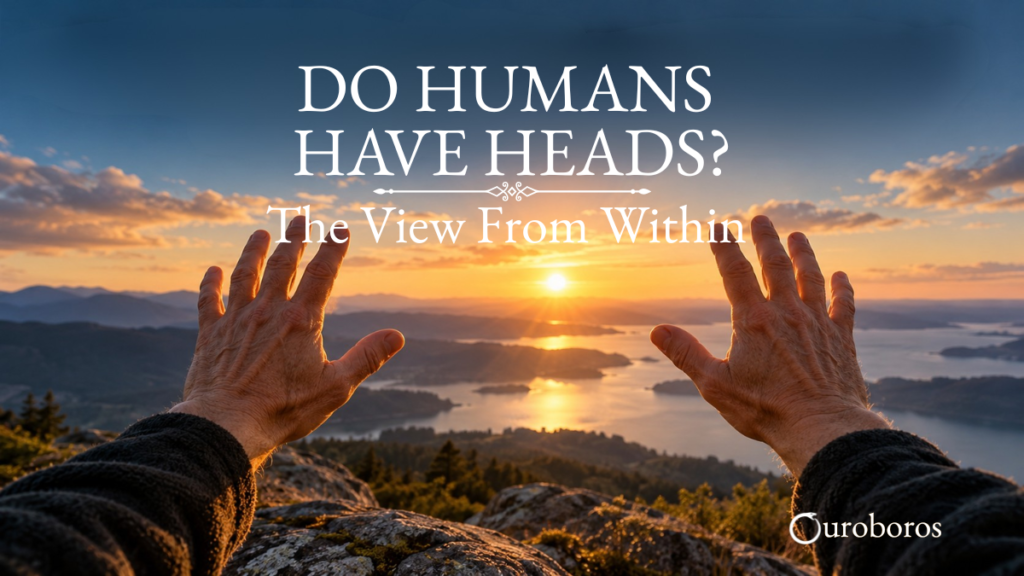

Do you have a head?
The answer seems so obvious that the question sounds ridiculous.
Of course you do.
Other people can see it. Mirrors can show it to you. Photographs provide rather convincing evidence.
But Douglas Harding, the English philosopher and mystic, suggested trying something unusual.
Forget for a moment what you know.
Look at what you actually experience.
Try a small experiment.
Point at something across the room.
There it is, at the end of your finger.
Now point at something closer. Perhaps your other hand, then your chest.
Finally, turn your finger around and point toward the place from which you are looking.
What do you actually see there?
Not what you know must be there. Not what a mirror would show you.
What do you see?
From your own point of view, there seems to be no face staring back at the world.
Instead, there is simply an open space in which everything appears.
Harding called this being “headless.”
He wasn’t suggesting that our heads don’t physically exist. His point was about the difference between what we have learned about ourselves and what we discover through direct experience.
From the outside, we are objects in the world.
But from the inside, the experience is very different.
There isn’t a little version of ourselves sitting somewhere behind our eyes watching everything happen.
There is simply seeing.
And that raises a curious question.
How much else about ourselves do we accept because we have learned to see ourselves from the outside?
Our name. Our age. Our appearance. Our history. The stories we tell about who we are.
All of them may be perfectly useful.
But are they the same thing as the one who is experiencing them?
Perhaps the strangest thing about asking whether we have heads is not the answer.
It is discovering how rarely we look before answering.