

Imagine waking up one morning and discovering that your memories are not your own.
The people you love, the childhood you remember, the experiences that shaped you—all of them may have been placed inside you.
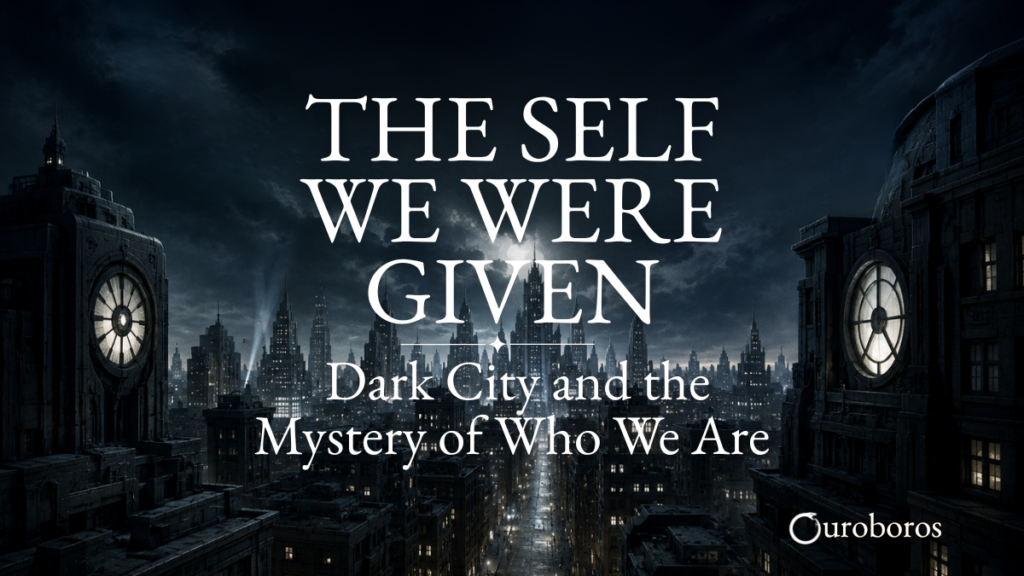
That is the unsettling idea at the heart of Dark City. Its inhabitants believe they know who they are, yet their identities are continually rearranged by mysterious beings who alter their memories and surroundings while they sleep.
It sounds like science fiction. But the question underneath it is surprisingly close to home.
How much of the person you call “me” did you actually choose?
Before we were old enough to question anything, we inherited a language, a culture, beliefs about success and failure, ideas about right and wrong, and countless assumptions about what kind of person we were supposed to become.
Eventually, the story became so familiar that we stopped noticing it was a story.
The ancient Gnostics also questioned whether the identity we ordinarily take ourselves to be is our deepest identity. Beneath the roles, beliefs and conditioning of everyday life, they believed there was something within us capable of awakening—and remembering.
Perhaps that is why Dark City remains so haunting.
Its deepest horror is not that someone’s memories might be false.
It is that they might never realize it.
And perhaps its deepest hope lies there too.
Because the moment we begin to examine the story we have been given, something unexpected becomes possible:
We may discover that the one examining the story was never entirely contained within it.