
There is a curious expression we hear increasingly often.
“Trust the science.”
Three simple words, usually offered as though they should bring a conversation to an end.
But what, exactly, are we being asked to trust?
Science is not a person. It has no voice, no opinions, and no beliefs.
People do.
And people, including scientists, can be mistaken.
This is not an argument against science. Quite the opposite.
Science is one of humanity’s most remarkable achievements precisely because it provides ways to discover when our understanding is wrong.
An observation leads to a question. A question suggests an explanation. That explanation is tested against the evidence.
Sometimes it survives. Sometimes it doesn’t.
And sometimes an entirely new understanding emerges.
The process is rarely as tidy as that description suggests. Scientists disagree. Experiments produce unexpected results. Established explanations are revised, refined, or occasionally abandoned.
But that willingness to be wrong is not a weakness.
It is one of science’s greatest strengths.
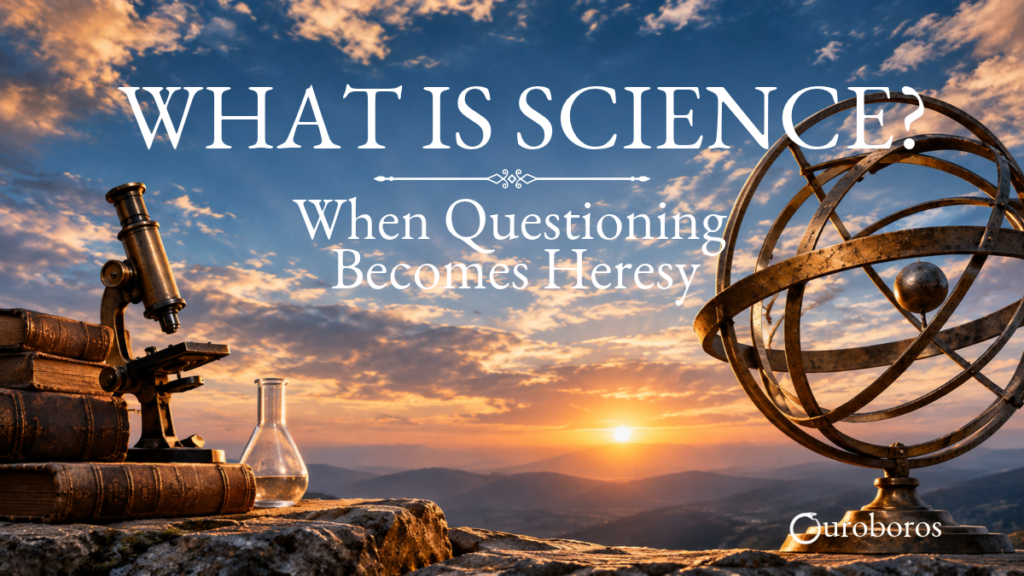
Science is a method for questioning authority, not an authority that should be beyond question.
Yet something curious happens when science leaves the laboratory and enters everyday conversation.
We begin hearing expressions such as “Science says” or “The science is settled.”
A method of investigation becomes a voice of authority.
And questioning that authority can sometimes be treated as though it were an act of disobedience.
But when did asking questions become the enemy of discovering answers?
There is, of course, an important distinction between questioning a scientific conclusion and simply refusing to accept evidence.
Not every alternative explanation is equally plausible. Not every opinion carries the same weight. And decades of careful research cannot reasonably be dismissed because someone finds the conclusions uncomfortable.
Expertise matters.
Evidence matters.
But neither requires the abandonment of curiosity.
We cannot personally repeat every experiment or investigate every scientific claim. Much of what we understand about the world depends upon the work of others.
The question is not whether we should listen to experts.
It is whether listening must mean surrendering our ability to think critically.
Perhaps the difficulty begins when we confuse confidence with certainty.
A conclusion supported by overwhelming evidence deserves considerable confidence. But confidence is not the same as declaring that no further questions may be asked.
Indeed, the history of science is filled with discoveries made possible because someone noticed that an accepted explanation was incomplete.
What was once considered obvious became questionable.
What was once considered impossible became imaginable.
And what was once confidently believed sometimes turned out to be mistaken.
This does not mean that everything we currently understand is wrong.
It means that understanding remains open to improvement.
There is something almost paradoxical about demanding unquestioning belief in a process whose very purpose is to test beliefs.
Perhaps science is most deserving of our trust when it remains willing to question itself.
And perhaps the same is true of us.
After all, a question does not become dangerous simply because it challenges an accepted answer.
But an answer may become dangerous when it is no longer permitted to be questioned.
So perhaps the most scientific question we can ask is also the simplest.
What if we’re wrong?