

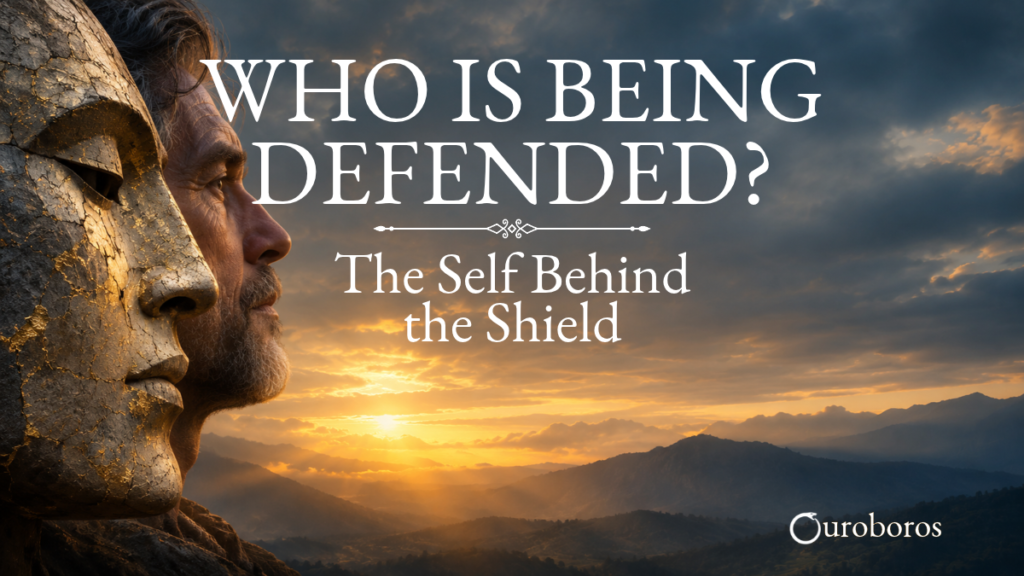

Someone criticizes us.
Perhaps they question our intelligence, challenge a belief, or say something unkind about our character.
Almost immediately, something rises within us.
We feel attacked. We want to explain ourselves, justify our position, or strike back.
Yet something rather curious has happened.
Nobody has touched us.
So what, exactly, is being defended?
We spend much of our lives constructing an idea of who we are. Our opinions, achievements, memories, beliefs, and the stories we tell about ourselves gradually become woven into something we call me.
And when one of those threads is pulled, the whole fabric can seem threatened.
A disagreement becomes a personal attack. A criticism becomes an insult. Someone questioning what we believe can feel remarkably similar to someone questioning who we are.
But are those really the same thing?
There are times when defending ourselves is entirely appropriate. Boundaries matter. Injustice deserves resistance. And not every criticism is fair.
Yet there is another kind of defence that seems to happen almost automatically.
We defend an opinion as though changing it would diminish us. We protect an image of ourselves even when maintaining it becomes exhausting.
Perhaps the difficulty begins when we forget that the person and the picture are not necessarily the same.
A belief can change without its holder disappearing. An opinion can be mistaken without making the person who holds it worthless.
And perhaps the freedom to question ourselves begins when we no longer need every part of our self-image to remain intact.
The next time something within us rises to defend itself, there may be a question worth asking before we respond.
Not whether we are right or wrong.
But who, exactly, is being defended?