

There is something rather strange about the world.
We all seem to live in the same one.
Yet nobody has ever experienced it through anybody else’s eyes.
Every color, every sound, every familiar object appears within an individual experience.
And somehow, billions of these private experiences seem to agree that there’s a world out there.
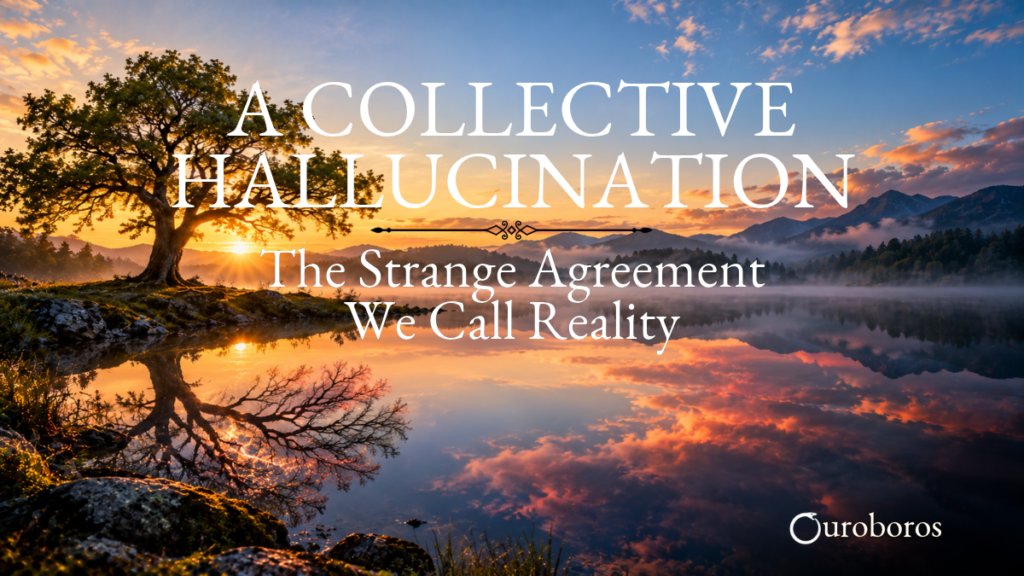
Consider something as ordinary as a tree.
We can stand beside it, touch its bark, watch its leaves move in the wind and agree that it is there.
But what each of us actually experiences is not the tree itself. It is an experience of the tree, assembled through our senses and nervous systems.
Light enters our eyes. Signals travel through our nerves. The brain interprets patterns of activity, and a world of colors, shapes and movement appears.
We don’t ordinarily notice this extraordinary process.
We simply see a tree.
And because other people see it too, we assume we’re all experiencing the same reality.
But are we?
The color I call green may not be quite the green another person experiences. The sound of rain, the taste of an apple, even the passage of time may feel subtly different from one mind to another.
We have no direct way of comparing these private experiences.
Yet somehow, our worlds overlap remarkably well.
We can agree where the tree stands, measure its height and predict when its leaves will fall.
This suggests something important. The fact that experience is constructed doesn’t mean the world is imaginary.
There may be a reality independent of our perceptions, even if we never encounter it without the interpretation of our senses.
Perhaps the strangest thing isn’t that each of us experiences a private world.
It’s that these private worlds fit together so convincingly.
We call this shared agreement reality.
But perhaps what we share is not the experience itself, only the remarkable consistency between our experiences.
And that leaves a curious possibility.
Maybe the world we agree upon is not quite the world as it is.
Maybe it’s the world as human beings have learned to see it.
What might reality look like without the human way of looking?